Participated in the 2026 Bucks County Public Library salute to local authors. Same as last year, even had the same table number. Got to talk to a lot of friendly visitors. This may be my last road trip promoting my writings for 2026.



Participated in the 2026 Bucks County Public Library salute to local authors. Same as last year, even had the same table number. Got to talk to a lot of friendly visitors. This may be my last road trip promoting my writings for 2026.
An outing for mid-July. One way to spend a birthday,
Once more, I was out showcasing my books, this time at a new local authors' book festival just south of Pottstown, Pennsylvania.
Attendance was sparse, but Linda and I got to meet many people, including our good friend and fellow author, Nancy A, Hughes.
 |
| Nancy Hughes talking with my wife, Linda |
 |
| Nancy and husband, Bill |
Since December I have attended a Book Fair at the Upper Merion Township library, the Horsham Public Library, and participated in a book discussion group at the Schuylkill Campus library of Penn State. Keeping busy.

Can Skinwalkers Swim? is now available from Amazon as a Kindle ebook for $4.99.
An easy way to go for those of you who prefer the electronic version.

First Saturday in November, I was down in Doylestown for the public library's annual book fair. I think I have my setup where I want it. Sold several copies of Taken Beyond the Ohio.
 | |
| At my table in Doylestown, PA, November 8th. |
Last weekend I was in Charlotte, North Carolina for the Southern Christmas Show. Huge venue with thousands of shoppers. I was one of eight authors selling our books at the Headline Books booth.
 |
| Manning my space at the Southern Christmas Show in the Headline Books booth. November 14th. |
Both long, hard days, but I learned a lot, made many contacts and sold a few copies of my latest book, Can Skinwalkers Swim?
We will be at the upcoming Bucks County Library Author Fair on November 8th.
Held at the Doylestown branch of the county library system.
Times: 10:30AM until 1PM. Location: 150 Pine Street in Doylestowwn.
We will have a table with copies of all our books available for sale and for signing.
Our newest novel, Can Skinwalkers Swim? will be available for purchase.
Lots of authors and events, so come visit the show and our table.


I have the second interview with Marilyn Klimco. Still looking for the third one, which I seem to have lost.
<https://www.bctv.org/video/michael-wescott-loders-book-beetle-the-autobiography-of-a-virtual-girl-pub-date-with-an-author/ >
A

In April I completed my third rug. It is the largest one I have attempted yet. The larger size and the need to put in the shuttle stick twice for each row of weft slowed me down. I also found the umbrella rib useful. This rug came out quite different. Still within the Navajo tradition, but unlike a
ny others I have seen. Still lots of mistakes, but the weaving is tighter and the lines sharper.
 |
| Running weft between the warps. |

Rug complete and ready to come out of loom.
 |
| Memories. Linda and one-and-half year old Laura in Ruins Canyon in 1980. |
In April, 2024, I started my second weaving project. This time I went with a larger size 24 inches by 38 inches. Two feet wide is about as wide as the tools and the loom I have can manage.
I finished the new rug on July 15th. I had a hard time controlling the width (too wide in the middle) and the length is off as well. Color changes proved to be a problem in the early stages but the second half looks clean. Over all I am pleased with the way the design came out. May think about a new project when the weather gets cooler. Please understand that what I am doing is not "Navajo Weaving" since I am not Navajo or Diné. I just weave using the Navajo technique.
 |
| Working at the loom. |
 |
| Sadie Curtis working the big loom at Hubbell's Trading Post in Ganado, 1979 |
Between 1978 and 1980, my family and I lived in Ganado, Arizona—in the heart of the Navajo Indian Reservation (Diné Nation). I worked as a librarian at the College of Ganado. In the spring of 1980, my wife took a course at the college in Navajo weaving.
 |
| Building a loom |
 |
| Linda gathering juniper berries for dye |
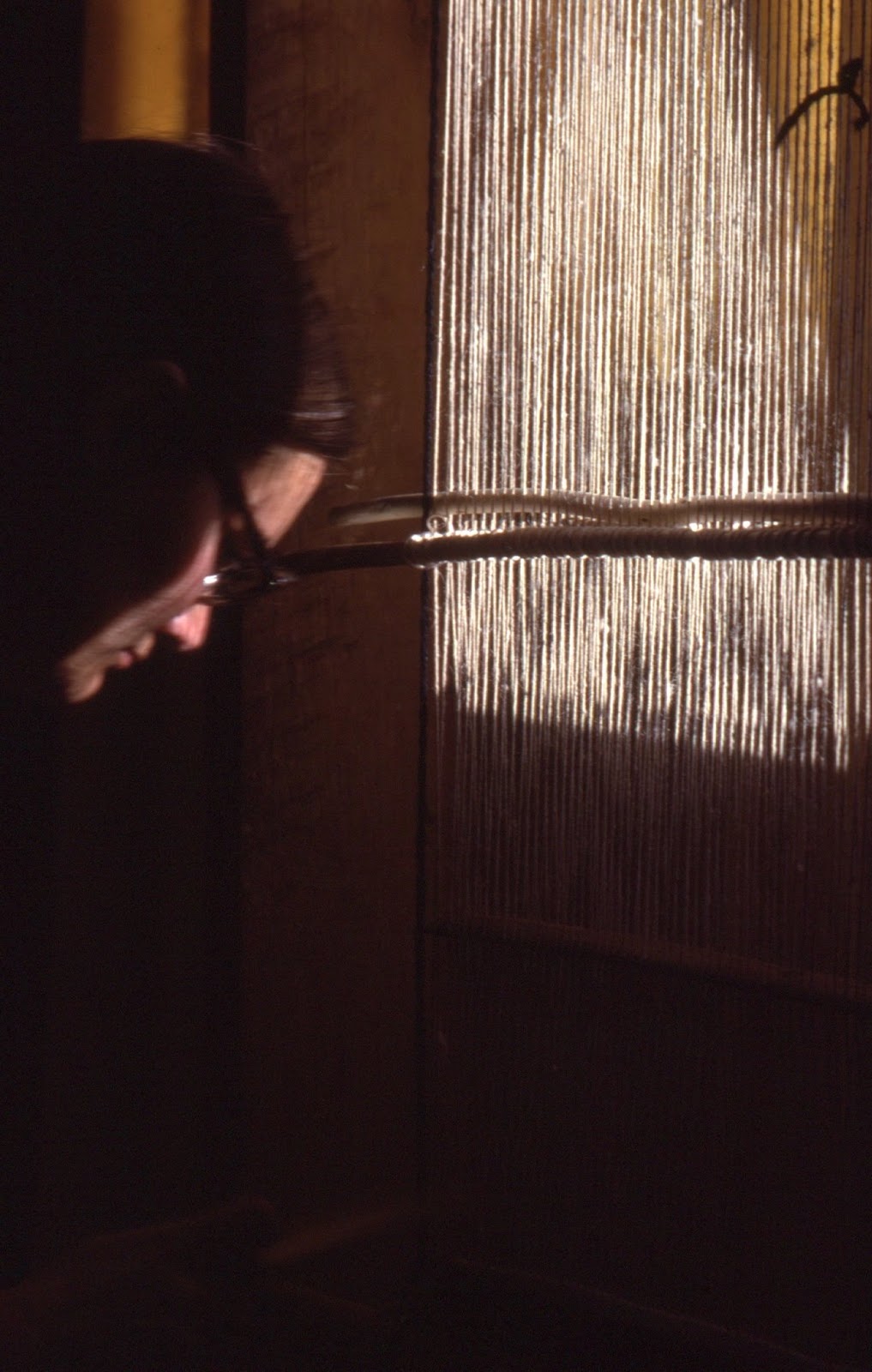 |
| Linda at the loom, 1980 |
All this got put on hold when we left Ganado and moved east for a new position in July 1980.
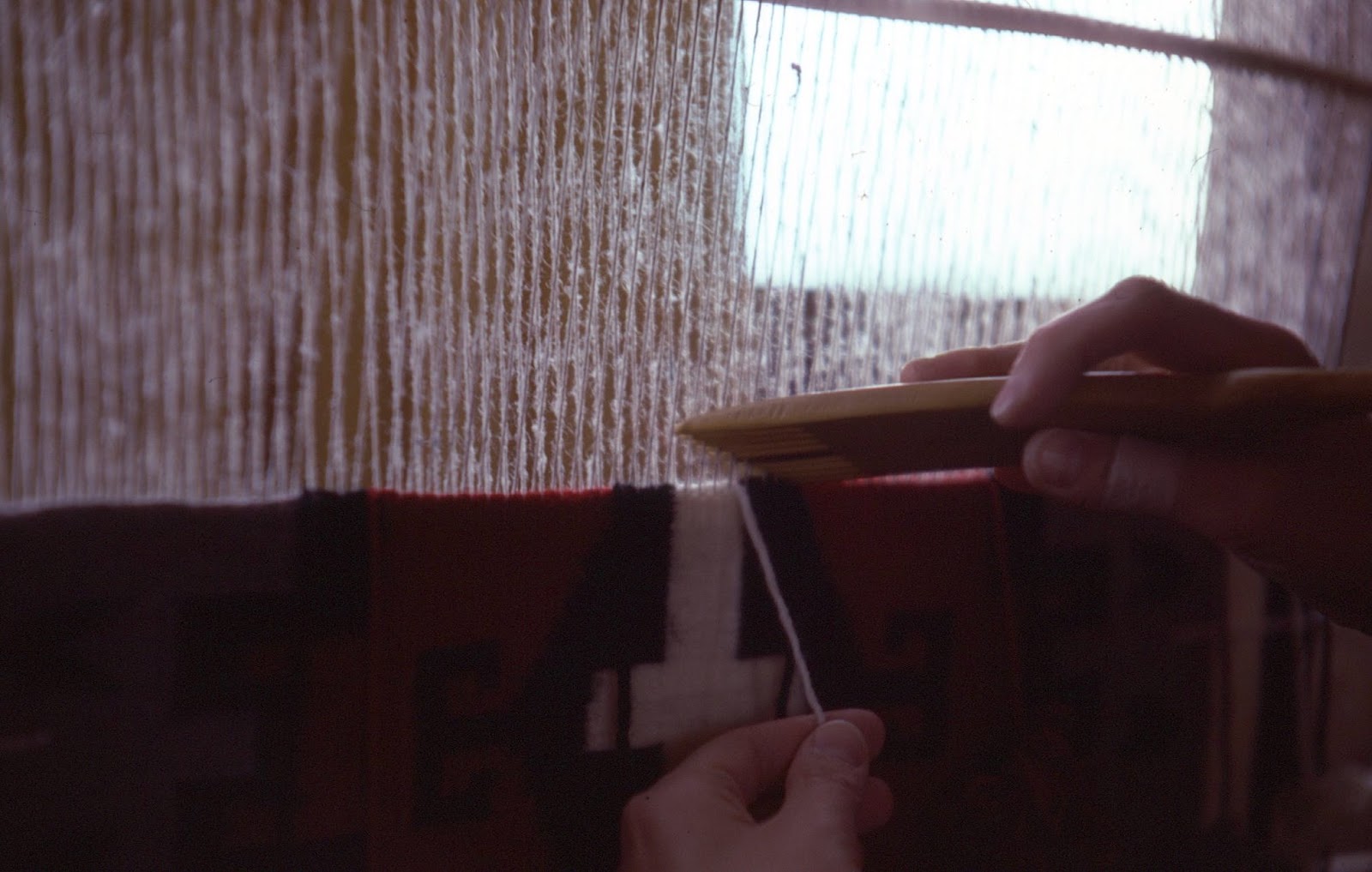 |
| Tapping in weft. |
 |
| Fitting in the last rows of weft. |
 |
| Linda's finished rug. Simple, but beautifully woven. |
 |
| Weaving tools brought from Arizona and saved for 44 years. |
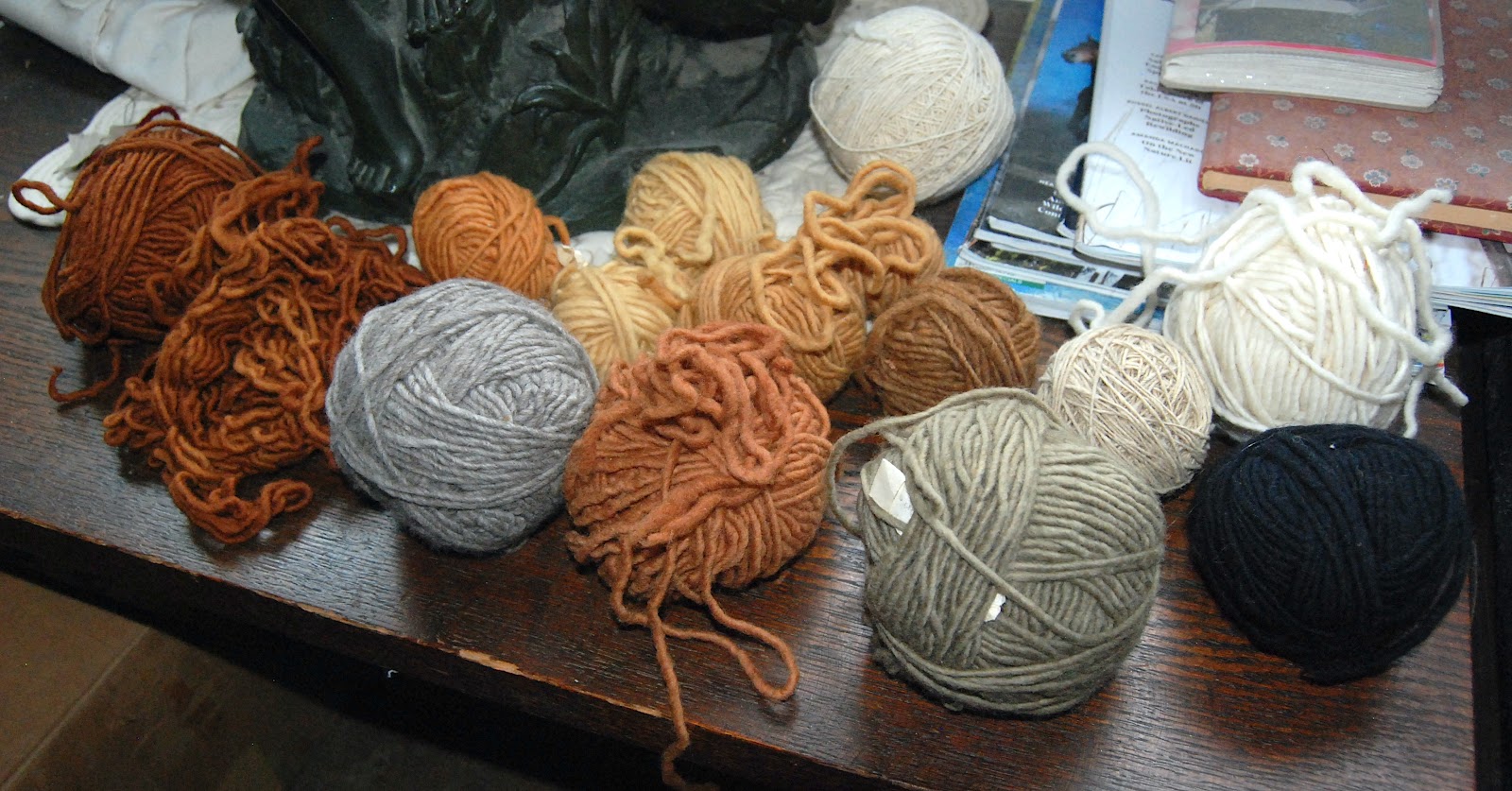 |
| Yarns saved, some with labels indicating the plants used for dyes. |
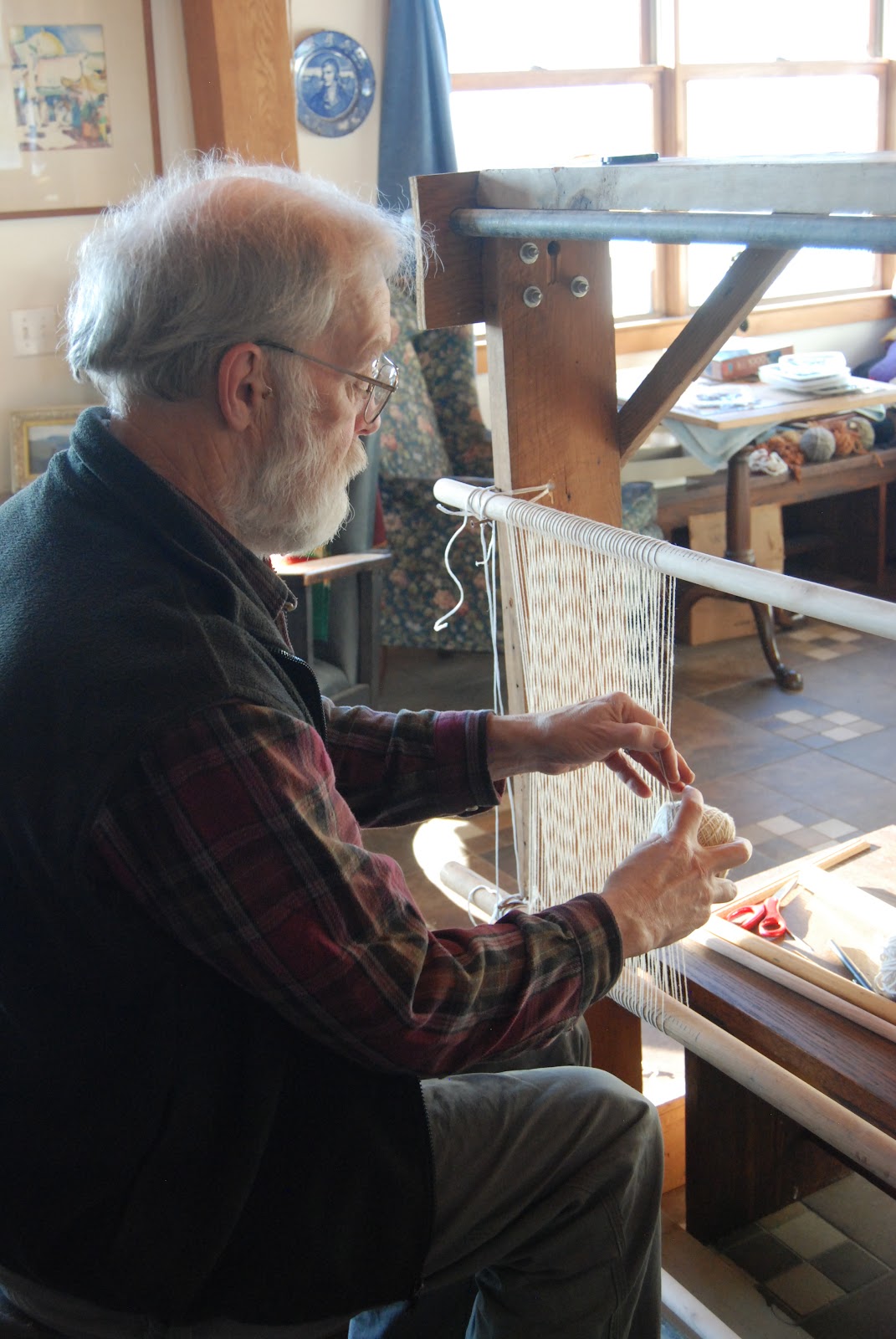 |
| Warping the loom |
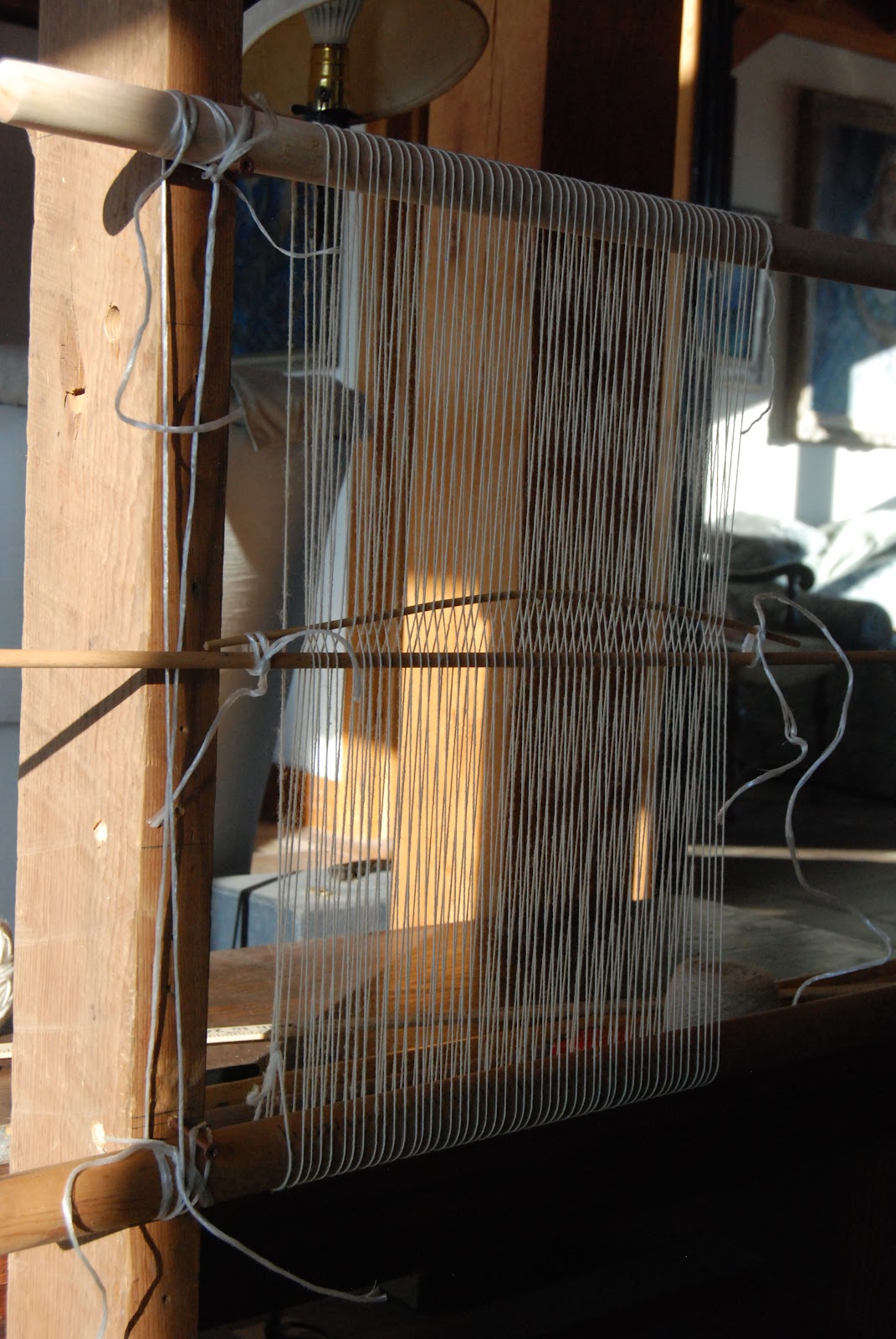 |
| Warping in place. |
 |
| Tying in the edges. |
 |
| First few rows of weft in place. |
 |
| The loom all ready for weft. |
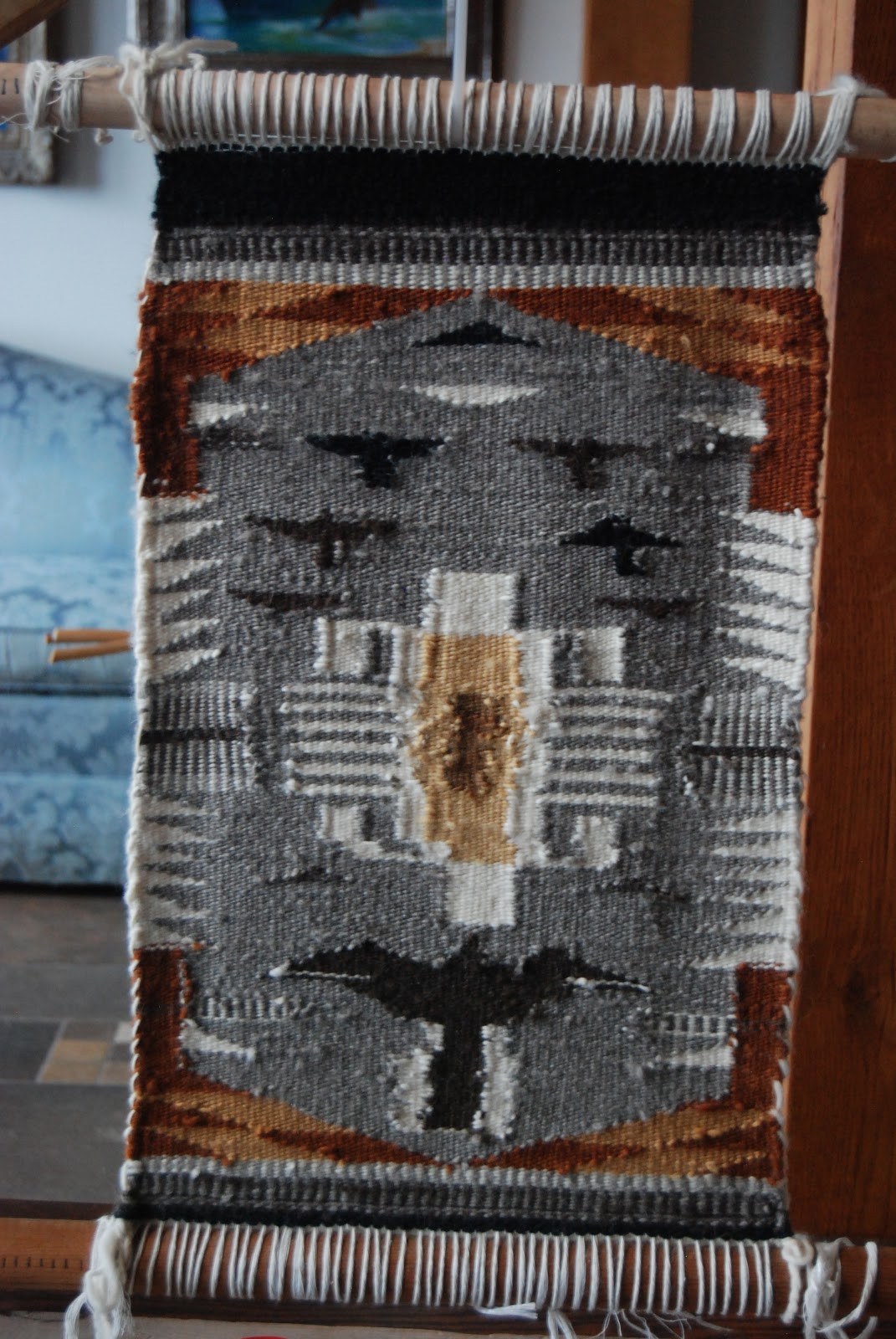 |
| Ready to come out of the loom |
 |
| The finished rug. Raven and Turtle |

Back in 1977 while studying for my masters in librarianship, I discovered the local bagpipe band, the Eugene Highlanders. Here was a chance to fulfill a lifelong dream. I had started studying the pipes back in 1963 as a freshman in college, but let the opportunity go. I would not give up on this second chance. I took lessons with the Pipe Major, Hector Smith, a Canadian-born lawyer who gave lessons for free if you joined the band. It was a wonderful experience and gave me a solid foundation that I used to build a musical career, first as a soloist, then Pipe Sergeant with the Cairngorm Pipe Band, then as Pipe Major for the Hawk Mountain Highlanders, a position I hold to this day.
Hector was patient, careful and always ready to help. I kept in touch with him for many years. In 1982, while working as a naturalist at Olympic National Park, I had an opportunity to attend the Portland Games and watch and record the Eugene Highlanders in competition. I do not remember how they did, but they sounded and looked sharp.
 |
| Hector Smith, Pipe Major |
 |
| Band warming up. |
 |
| Hector listening to pipes while Pipe Sergeant tunes. |
 |
| Playing in the competition circle. |
 |
| March off after competing. The young woman in the center is Maggie Thorpe (maiden name). She was a student of Hector's at the same time I was, and we got to know each other pretty well. I doubt any pipe band uses that small a bass drum anymore. |
As we live through current events, perhaps a look back at previous tremendous times might give some sense of balance. Andrew Jackson is today a controversial figure in American history, but he was popular during his presidency—only to have his fiscal policies turn to economic disaster during the administration of his hand-picked successor, Martin Van Buren. Political coins were popular tokens during the early 19th Century. Here we have two such “coins.” In size and copper makeup, they are like the United States large cent of that period (which in turn was modeled after the British penny). The date of these tokens is not certain, but the clearly relate to the Jackson and Van Buren administrations, and the one date of 1837 suggests that they were minted in response to the Panic of 1837—the worst economic crisis the United States would face until the Great Depression of the 1930s.

In the first picture we see the two tokens placed with a 1846 one cent piece for scale. Below is a closeup of the obverse of the two tokens and below the reverse of the same tokens.

To the left we see an image of Jackson, sword in one hand, money bag in the other emerging from a treasure chest. The inscription reads: “I TAKE THE RESPONSIBILITY.” The reverse shows the Jacksonian donkey or Jackass (still the symbol of the Democratic Party) with the text: “THE CONSTITUTION AS I UNDERSTAND IT,” with “ROMAN FIRMNESS and “VETO” above and below the donkey. The donkey’s body once had letters, but only a ‘D’ remains. [Jackson was the first president to actively use the veto power.]

To the right we see a turtle with a money box on its back labeled “FISCAL AGENT.” The words “EXECUTIVE EXPERIMENT” and the date 1837 complete the lettering except for a label on the money box which might read “SUB TREASURY.” On the reverse of this token, the Jacksonian donkey again appears, this time running, with the motto, “I FOLLOW IN THE STEPS OF MY ILLUSTRIOUS PREDECESSOR”: an obvious reference to Van Buren’s sticking to Jackson’s fiscal policies.
Yes, the donkey or jackass as a symbol of the Democratic Party dates back before Thomas Nast, and yes, what happened then led to the formation of modern American political parties. Back then, people didn’t put sign in their yards, they carried around tokens instead, which they gave away or even used as money.